Current Threshold Context
The 0.2% threshold of THC was established with criteria that have no documented pharmacological studies linking it to psychoactivity or safety. Its historical evolution reflects diverse considerations.
The "Inventors": Small and Cronquist (1976)
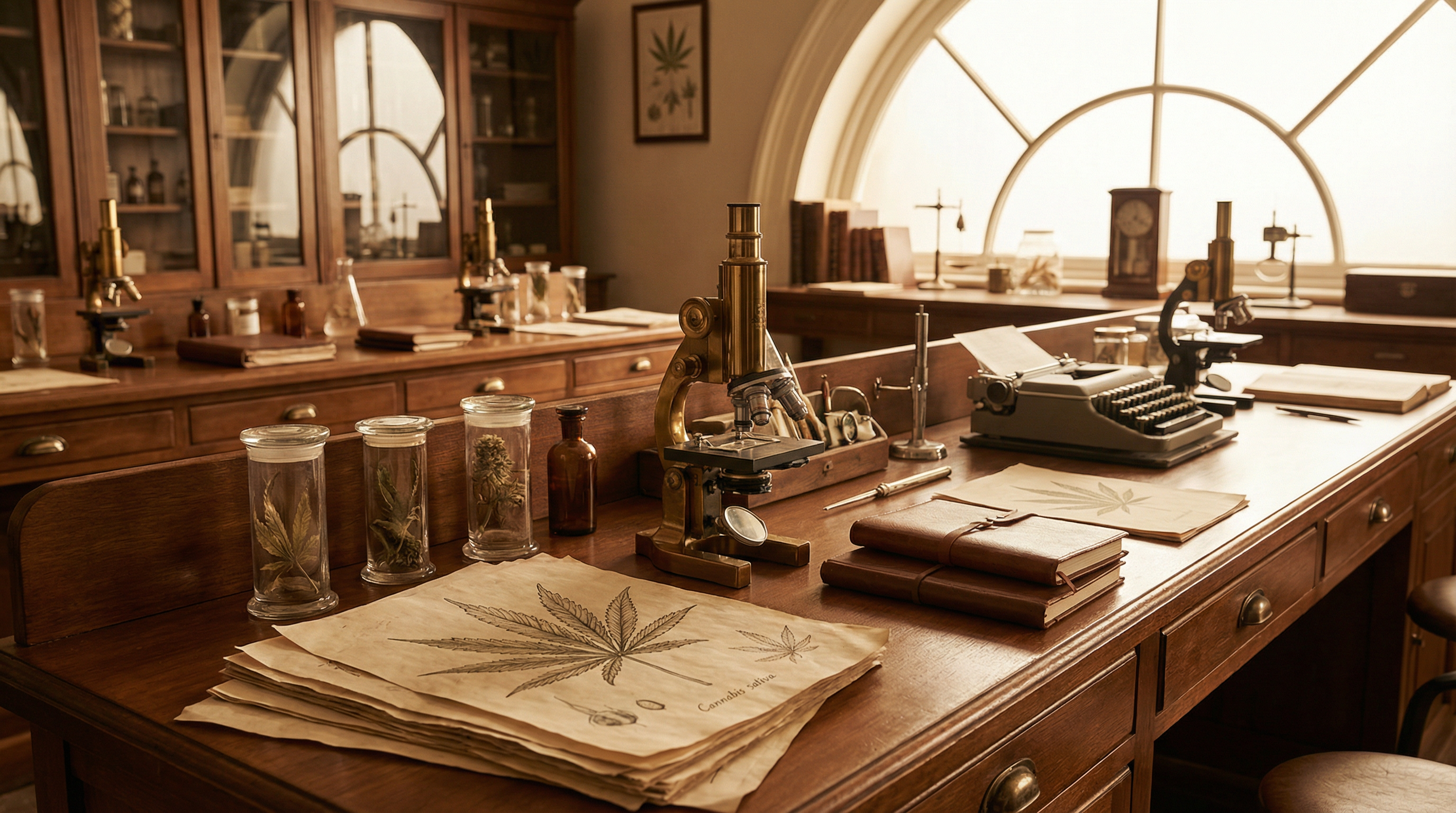
Recreation of the scientific atmosphere in which Small and Cronquist developed their taxonomy of cannabis in 1976.
📷 AECANI Visual Lab
In 1976, botanists Ernest Small (Canadian, plant genetics expert) and Arthur Cronquist (American, taxonomist) published a study that would be instrumental in the regulation of cannabis worldwide
A Practical and Natural Taxonomy of Cannabis (1976)
This study proposed that a THC content of 0.3% dry weight should serve as a dividing line between hemp (Cannabis sativa var. sativa) and marijuana (Cannabis sativa var. indica).
⚠️ Crucial Fact: They measured in LEAVES, not flowers
Small and Cronquist established the threshold by measuring THC in "young, vigorous leaves of relatively mature plants ", NOT in flowers/cogs. This is important: flowers have much higher THC concentrations than leaves.
"We arbitrarily adopted a concentration of 0.3% THC in dry weight of young, vigorous leaves of relatively mature plants as a guide to discriminating two classes of plants.
The Context of the Definition
The authors themselves pointed out that the 0.3% threshold was set without specific pharmacological rationale (somewhat arbitrary, in their words). They did not rely on studies of what concentration causes psychoactive effects.
Scientific Context of the Period
To understand why they chose that threshold, one must go back to 1976
- 1964: Raphael Mechoulam had isolated THC only 12 years earlier. Research was in its infancy
- 1976: There was no commercial CBD. Cannabidiol was a laboratory curiosity
- 1976: Chromatography was rudimentary. Techniques to accurately measure cannabinoids were not developed
- **1976: Nobody consumed hemp flowers. Hemp was exclusively for fiber and seed
Chronology: From 0.3% to 0.2%
The evolution of THC limits in Europe shows how the threshold was adjusted for various reasons, with no documented scientific studies to support each change
Small and Cronquist propose 0.3%
Taxonomic study 'A Practical and Natural Taxonomy of Cannabis'. The authors note that the threshold lacks specific pharmacological rationale. It is measured in leaves, not flowers.
📚 Taxon 25(4): 405-435
EU establishes 0.5% limit
First THC limit in the Common Agricultural Policy (PAC) for industrial hemp subsidies. why 0.5%? No clear documentation.
📚 EIHA Position Paper
EU reduces to 0.3%
The threshold proposed by Small/Cronquist is adopted. No new studies to justify the change.
EU reduces to 0.2% (sectoral initiative)
Reduction promoted mainly by agricultural sectors of producing countries. France was the largest hemp producer in the EU and its varieties had low THC.
📚 High Green News, EIHA
EU returns to 0.3%
The European Parliament votes to restore 0.3% in the new PAC, considering that 0.2% presented challenges for the sector.
📚 Forbes
Proposal to increase to 0.5%
MEPs propose an increase to 0.5% and establish a uniform legal definition in all Member States.
📚 Hemp Today
0.2% Comparative Context
The 0.2% limit applicable in Spain is more restrictive than the original threshold of Small and Cronquist (0.3%), who also measured in leaves, not flowers.
Confusion: Subsidy ≠ Security
Over the years, what was a criterion for granting agricultural subsidies was mistakenly transformed into a public safety threshold
Legislators and authorities began to assume that "if 0.2% is the limit for legal hemp, then anything above it must be psychoactive or dangerous". This interpretation has no documented scientific support
A product with 0.5%, 0.8% or even 1% of THC does not produce significant psychoactive effects when it contains sufficient CBD (THC:CBD ratio greater than 1:10), according to available scientific evidence
Why 1% THC is the Correct Scientific Threshold
Unlike the 0.2% (purely administrative), the 1% of THC does have solid scientific foundations
- European Pharmacopoeia (Ph. Eur. 11.5, 2024): Officially classifies the CBD-dominant chemotype as "maximum 1% THC"
- United Nations ST/NAR/40 Manual: The official ONU technical protocol uses 1% THC as the reference threshold
- Pharmacological Studies: Gibson et al., Egloff et al. show that products with 1% THC and high CBD do NOT produce psychoactive effects
- German Pharmacopoeia (DAB 2020): Germany uses 1% THC as the minimum threshold
- Global Regulatory Trend: Switzerland, Czech Republic, Malta have already adopted thresholds higher than 0.2%
NLP 2023: Congressional Harmonization Proposal
On January 25, 2023, the Spanish Congress of Deputies approved a Proposición No de Ley (PNL) that specifically calls for raising the THC threshold to 1% for industrial hemp
The PNL argues that:
- The 0.2% is a threshold inherited from CAP with no documented scientific rationale.
- The UN ST/NAR/40 Manual recognizes 1% as an international technical standard.
- The European Pharmacopoeia classifies the CBD chemotype as maximum 1% THC.
- Products with 1% THC and high CBD are NOT psychoactive according to clinical studies.
Considerations on the 0.2% Threshold
- Incidents in the Agricultural Sector: Crops with natural variations of 0.5-0.8% THC have generated procedures
- Harmonization of Intra-EU Trade: Products with different thresholds raise opportunities for coordination
- Access to Genetics: The most productive varieties have profiles of 0.4-1% THC
- Legal certainty: The natural variability of the plant poses compliance challenges
International Trend: Countries with 1% THC
Comparison of THC Thresholds by Country
| Country | THC Limit | Legal Instrument |
|---|---|---|
| 🇨🇭Switzerland | 1.0% | Narcotics Act (Rev. 2011/2022) |
| 🇨🇿Czech Republic | 1.0% | Psychomodulatory Substances Act (2025) |
| 🇨🇴Colombia | 1.0% | Decree 811 (2021) |
| 🇪🇨Ecuador | 1.0% | Hemp Regulation (MAG) |
| 🇺🇾Uruguay | 1.0% | Decree 372/014 |
| 🇲🇽Mexico | 1.0% | Amparo 355/2020 (Supreme Court) |
| 🇹🇭Thailand | 1.0% | Narcotics Committee Notification |
| 🇦🇺Australia | 1.0% | Industrial Hemp Acts |
| 🇱🇧Lebanon | 1.0% | Law 178/2020 |
| 🇿🇼Zimbabwe | 1.0% | Statutory Instrument 218/2020 |
| 🇮🇹Italy | 0.6% | Law 242/2016 (tolerance) |
| 🇪🇸Spain | 0.2% | CAP (1999 Legacy) |
Proposal: Distinguish Fiber/Flower Seed
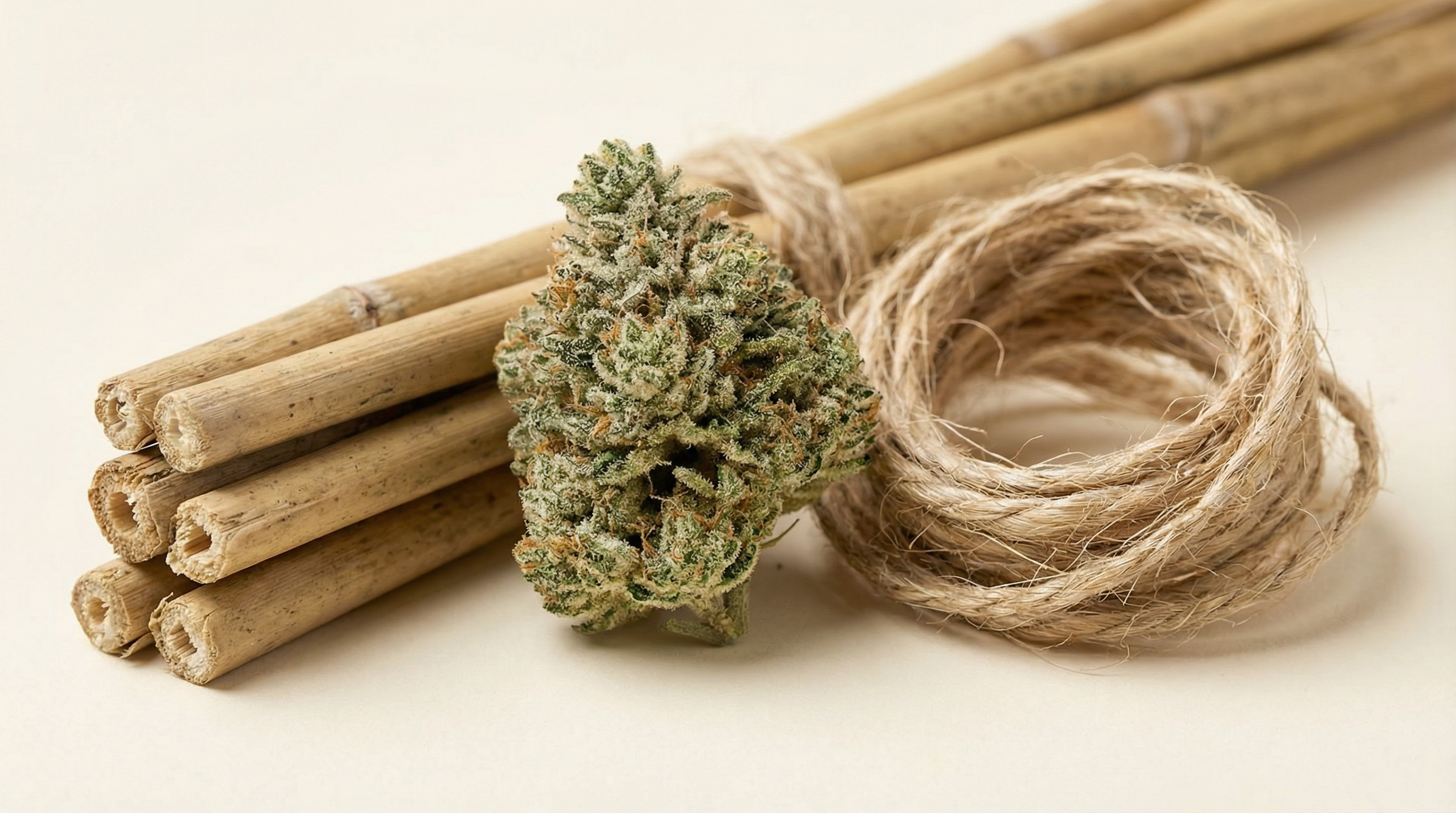
Visualization of the morphological difference between the resin-rich flower (right) and the fibrous stem (left), justifying their different regulatory treatment.
📷 AECANI Visual Lab
The AECANI Technical Position
Hemp grown for fiber and seed (TARIC fiber) is not the same as final flowers marketed as a product (code NC 1211.90.86). They should have different regulatory treatments.
Fiber/Seed Hemp
Agricultural TARIC codes
0.3-0.5% THC
Acceptable for CAP grants
Final Flowers (NC 1211.90.86)
Marketed product
1% THC
Based on scientific evidence
The AECANI Position
AECANI proposes a harmonized standard of 1% of THC for industrial hemp flowers (NC 1211.90.86) in the European Union, based on
- **Legal feasibility: There is no explicit 1% prohibition for flowers
- Scientific basis: Clinical trials demonstrate absence of psychoactivity
- Proportionality: Ruling Kanavape requires scientific justification
- International trend: +12 countries are already applying 1% THC
- Economic need: Eliminate barriers, foster competitiveness
**Hemp flowers with up to 1% THC and high CBD = safe, NON-psychoactive agricultural product, which should enjoy free circulation of goods in Europe **
📚 References
- Small, E. & Cronquist, A. (1976) - "A Practical and Natural Taxonomy of Cannabis". Taxon 25(4): 405-435
- European Industrial Hemp Association (EIHA) - Press Release on THC Limits
- Sabaghi, D. (2021) - "EU Increases THC Level for Industrial Hemp". Forbes
- High Green News - "European Hemp Farmers Feeling Hampered by EU's Low THC Limit"
- Gibson et al. (2022) - Clinical trial on CBD-rich hemp flower vaporization
- (2023) - Study on CBD-rich cannabis inhalation effects