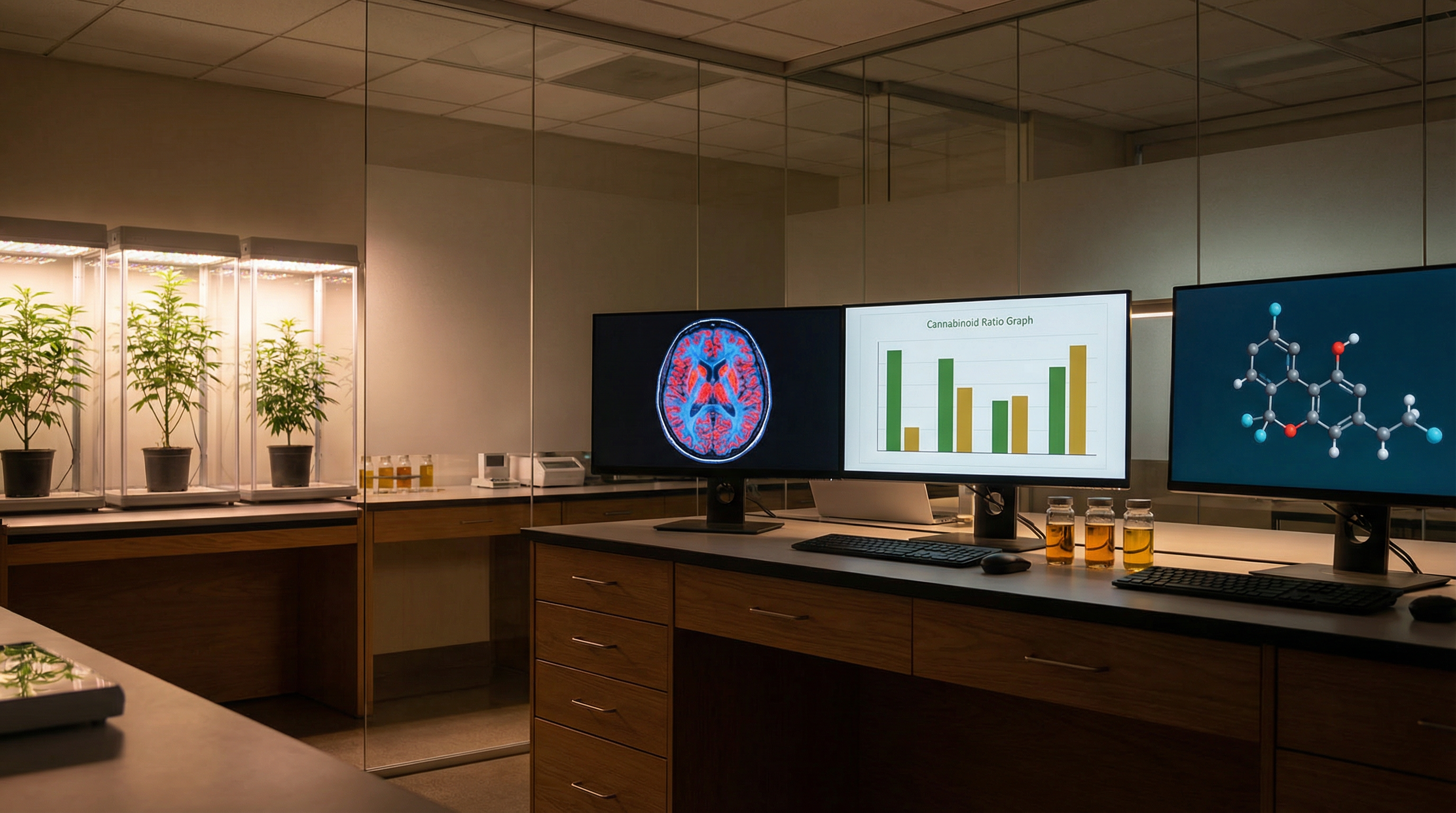
The interaction between CBD and THC determines the final pharmacological profile of the plant, beyond the isolated percentages.
📷 AECANI Visual Lab
The Key Concept
A THC:CBD ratio greater than 1:10 guarantees the absence of psychoactive effects, even if the THC content reaches 1%.
Recent Scientific Evidence
Several clinical trials have analyzed the effect of vaporizing or ingesting cannabis with 1% THC and high levels of CBD
Gibson et al. (2022)
Ensayo aleatorizado: la vaporización de flores con 1% THC y ~10% CBD no mostró diferencias significativas con el placebo en pruebas de deterioro cognitivo o subjetivo.
Egloff et al. (2023)
Estudio sobre conducción: el consumo de "cannabis light" (CBD > 10%, THC < 1%) no afectó la capacidad de conducir ni produjo efectos subjetivos de intoxicación.
How does the CBD work against the THC?
The CBD mitigates the effects of THC through several biological mechanisms
- CB1 receptor modulation: The CBD prevents the THC from binding strongly to the receptor responsible for psychoactivity
- Anxiety reduction: Counteracts the paranoia and tachycardia that pure THC can produce
- Entourage Effect: The combination of cannabinoids and terpenes in the whole plant creates a safety profile superior to that of isolates
Rigorous clinical trials are the basis for debunking myths about the dangerousness of low levels of THC.
📷 AECANI Visual Lab
Regulatory Implications
Given that scientific evidence indicates that 1% of THC with high CBD does not present narcotic characteristics, the 0.2% threshold could be revised considering the proportionality principle established by TJUE
Regulatory Opportunity
A threshold that takes into account the THC-CBD interaction would provide a stronger scientific basis. The available evidence on the neutralizing effect of CBD could inform a revision of the current framework.
📚 References
- Gibson et al. (2022) - Effects of Cannabidiol-Dominant Cannabis on Driving and Cognitive Performance
- Egloff et al. (2023) - Subjective and objective effects of CBD-rich cannabis inhalation
- Morgan et al. (2010) - Impact of CBD on the cognitive effects of THC