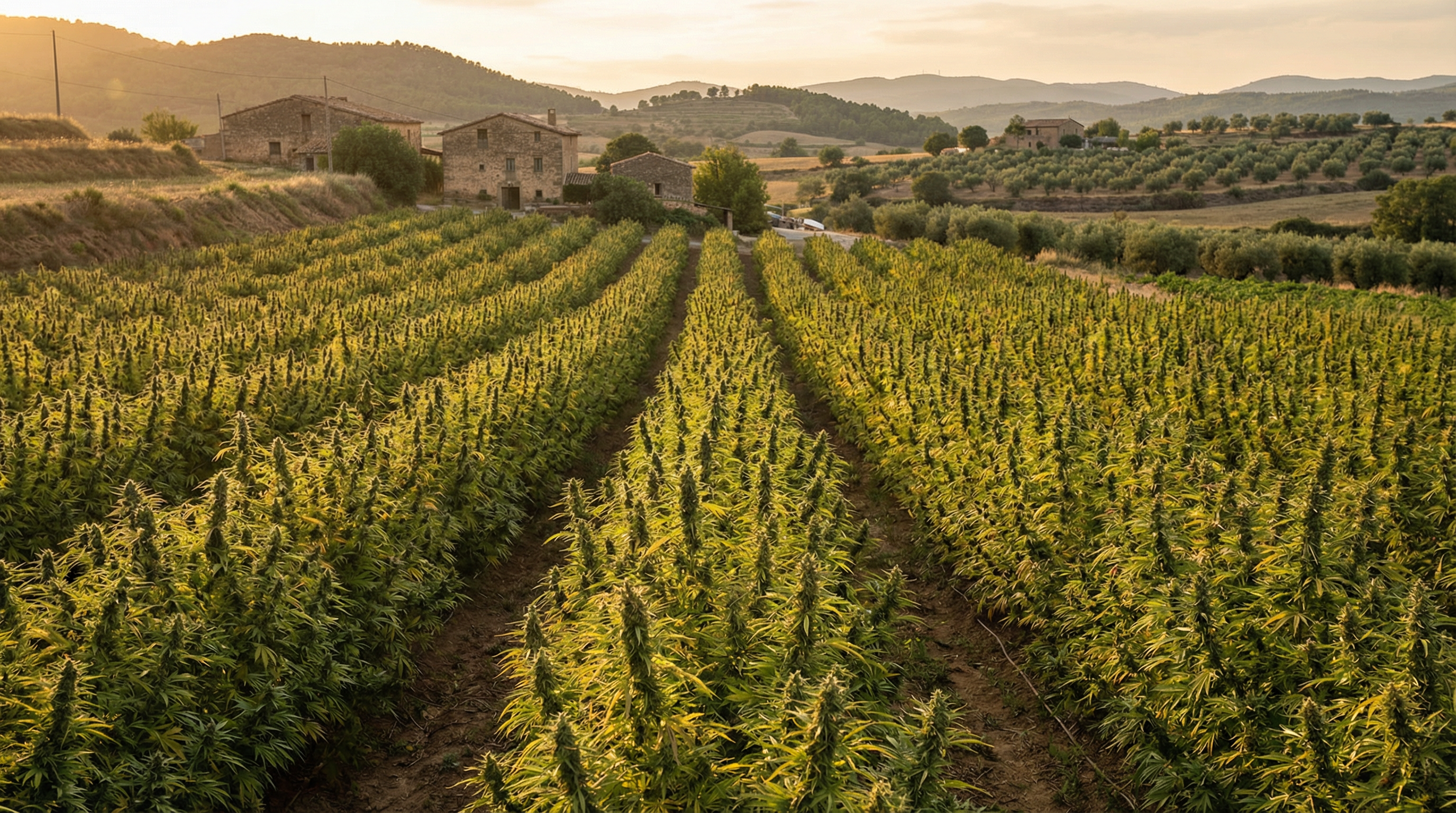
Industrial hemp cultivation represents an opportunity for Spanish agriculture that requires a clear and proportionate regulatory framework.
📷 AECANI Visual Lab
Current Competency Framework
In Spain there are two regulatory pathways for cannabis cultivation: the agricultural route (MAPA) for fiber and seed, and the health route (AEMPS) for uses that include flowering tops. This duality creates clarification opportunities.
The Competency Framework
Ministry of Agriculture (MAPA)
Industrial hemp cultivation intended exclusively for fiber, grain, and seeds is managed through the agricultural delegations of the Autonomous Communities. This cultivation:
- Is not subject to narcotics legislation
- Requires certified seeds from the EU Common Catalogue
- Must maintain a THC content below 0.3% (CAP 2023 threshold)
- Is declared through the SIGPAC system
Spanish Medicines Agency (AEMPS)
AEMPS maintains competence over crops whose purpose includes flowering tops, regardless of THC content. According to their interpretation:
- Flowers are controlled under the 1961 Single Convention
- Express authorization from AEMPS is required
- The destination must be medicinal, scientific, or research
Interpretation of the 1961 Convention
The regulatory debate centers on the interpretation of the 1961 Single Convention on Narcotic Drugs. This convention defines cannabis as:
""The flowering or fruiting tops of the cannabis plant (excluding seeds and leaves not accompanied by the tops) from which the resin has not been extracted."

The interpretation of international narcotics conventions presents opportunities for updating according to modern scientific evidence.
📷 AECANI Visual Lab
Interpretive Divergences
Literal Interpretation
Considers that flowering tops are controlled regardless of THC content, based on a strict reading of the 1961 Convention.
Scientific Interpretation
Points out that the Convention controls cannabis for its psychoactive effects (THC), not for its botanical morphology. Hemp with low THC does not present such effects.
CJEU Criterion
The Kanavape Ruling (C-663/18) established that CBD is not a narcotic and that a Member State cannot prohibit the marketing of CBD products legally produced in another State, regardless of whether they come from flowers.
Current Sector Situation
Operational Context
The current situation presents the following characteristics:
- Cultivation for fiber/seed: Clear framework under MAPA competence
- Cultivation for flowers: Requires AEMPS authorization
- Flower imports: Legal products in other EU Member States
Special Anti-Drug Prosecutor's Instruction (2021)
In June 2021, the Special Anti-Drug Prosecutor's Office issued an instruction establishing criteria for action in cases related to hemp cultivation. This instruction:
- Arose due to the diversity of criteria among territorial prosecutors
- Establishes that flowering tops are considered controlled
- Is based on the literal interpretation of the 1961 Convention
Aspect to Consider
The prosecutor's instruction has generated situations where farmers with declared crops and certified seeds have faced proceedings. This suggests the need for regulatory clarification to provide legal certainty to the sector.
Jurisprudential Evolution
Spanish courts have issued rulings with diverse criteria:
Relevant Rulings
- ✓Acquittals based on the CJEU Kanavape doctrine
- ✓Recognition that the THC percentage is relevant
- ✓Return of seized products in several cases
Article 3.1 of the Royal Decree
During the processing of the Royal Decree on medical cannabis, the initial draft included an article 3.1 that would have classified flowering tops as narcotics regardless of their THC content.
Result of Sector Dialogue
After a process of consultation and dialogue with the sector, the Ministry of Health removed article 3.1 from the final text. This result demonstrates the value of constructive dialogue between the administration and sector representatives.
The elimination of this article:
- Prevented automatic classification of all flowers as controlled
- Maintains the current framework pending development
- Allows the harmonization debate to continue
International Comparison
While Spain maintains the debate on hemp flowers, other countries have developed frameworks that clearly distinguish industrial hemp from psychoactive cannabis:
Hemp Flower Regulation by Country
| Country | THC Threshold | Flowers Allowed |
|---|---|---|
| 🇨🇭Switzerland | 1.0% | Yes, retail sales |
| 🇨🇿Czech Rep. | 1.0% | Yes, regulated framework |
| 🇮🇹Italy | 0.6% | Yes, with tolerance |
| 🇫🇷France | 0.3% | Debate ongoing |
| 🇪🇸Spain | 0.3% | Pending clarification |
AECANI's Proposal
AECANI proposes a regulatory framework that provides legal certainty to the sector, based on:
1. Competency Clarification
Precisely define which crops fall under MAPA and which under AEMPS, considering THC content as an objective criterion.
2. 1% THC Threshold
Adopt the scientific standard of the European Pharmacopoeia and the UN ST/NAR/40 Manual for industrial hemp flowers.
3. CJEU Harmonization
Incorporate the Kanavape doctrine into the Spanish regulatory framework, guaranteeing free circulation of legal products in the EU.
4. Legal Certainty
Establish clear criteria that allow farmers and companies to operate with certainty about the legality of their activities.
"The industrial hemp sector generates more than 10,000 jobs in Spain. A clear and proportionate regulatory framework would help consolidate this industry and attract investment to the Spanish agricultural sector.
Our Position
AECANI considers that there is an opportunity for harmonization of the Spanish framework with EU regulations and international scientific standards. We propose a constructive dialogue with the competent authorities to develop regulation that provides legal certainty to the sector while ensuring public health protection.
📚 References
- Single Convention on Narcotic Drugs (1961) - United Nations
- CJEU Ruling C-663/18 - Kanavape Case (19 November 2020)
- Royal Decree 903/2025 - Medical cannabis in Spain
- NLP 161/004241 (2023) - Congress of Deputies
- MAPA Informative Note - Industrial hemp cultivation
- European Pharmacopoeia (Ph. Eur. 11.5) - Cannabis Monograph