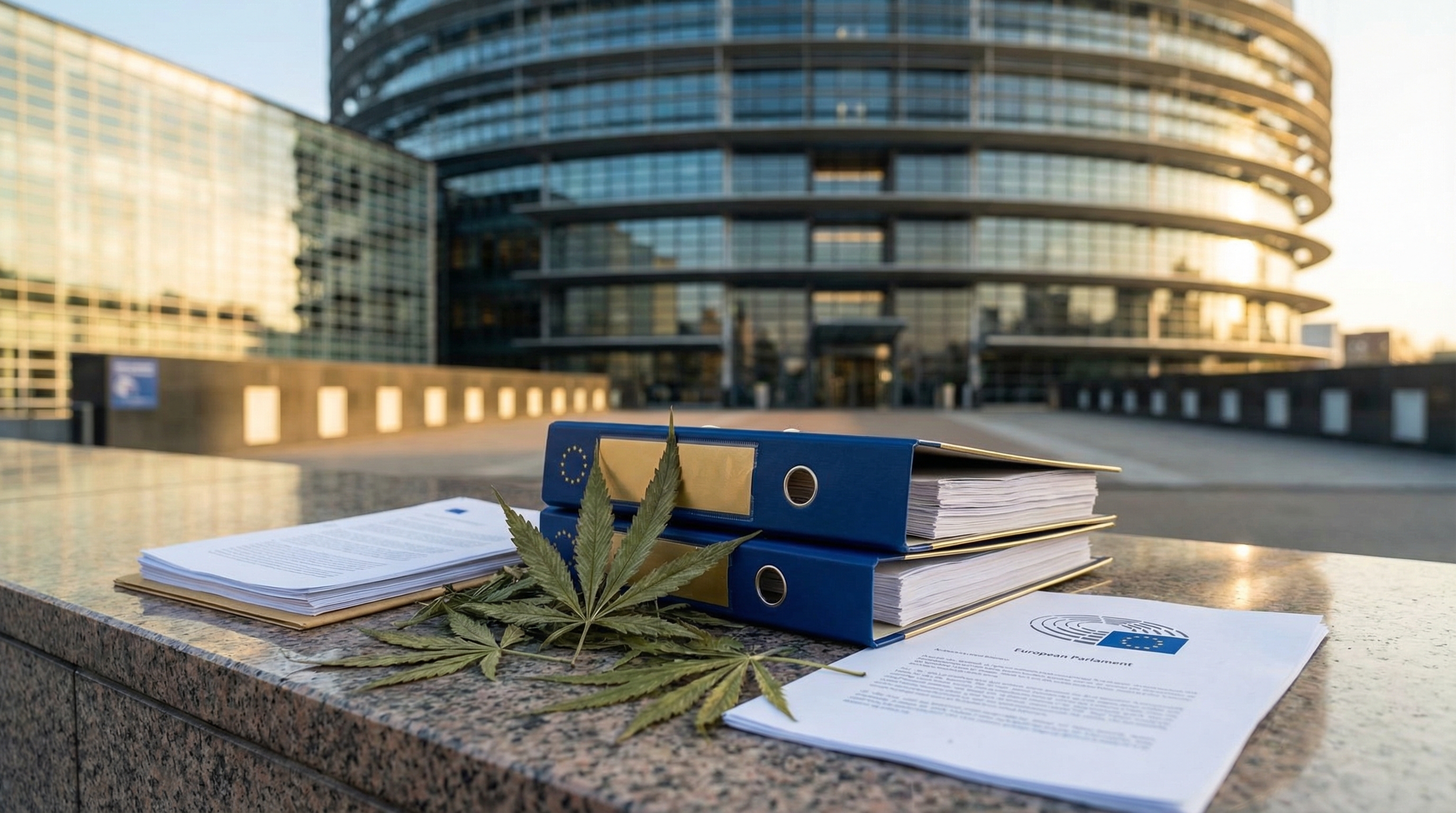
Essentials of COM(2025) 553
The European Commission proposes that all parts of the hemp plant, including flowering tops, be recognized as agricultural products within the CMO, subject to a maximum threshold of 0.3% of THC and to the use of certified seeds from the Common European Catalogue.
Key Recitals: 19, 20 and 21
The preamble of the proposal contains three recitals that constitute a paradigm shift in European hemp regulation.
Considering 19: Hemp as an agricultural opportunity
""Innovation and the growth of the bioeconomy have led to new applications for hemp biomass derived from all parts of the plant. This provides farmers with additional opportunities to valorize the plant beyond fiber production, making hemp a more attractive and competitive crop."
The Commission recognizes that hemp offers environmental and climatic benefits: it does not require pesticides or fertilizers and improves soil structure. Several hemp products, including raw hemp (CN 5302), seeds (CN 1207 99 91) and other parts of the plant (CN 1211 90 86), are listed as agricultural products in Annex I of the TFEU.
Recital 20: National divergences as a problem
""Some Member States have adopted national measures, for health protection reasons, prohibiting the production or marketing of certain hemp products. These divergent national approaches undermine the proper functioning of the common market organization, create legal uncertainty and barriers in the internal market and cause unfair competition between farmers in different Member States."
This recital is fundamental for the Spanish sector. The Commission identifies exactly the problem facing hemp farmers and companies in Spain: uncertainty as to whether hemp flowers with low THC are a legitimate agricultural product or a narcotic drug.
Recital 21: Hemp flowers are not narcotic drugs
Recital 21 - Textual Quotation
"It follows from the case law of the Court of Justice in Case C-663/18 (Kanavape) that non-psychoactive products such as cannabidiol derived from hemp varieties with low delta-9-tetrahydrocannabinol content are not to be considered as narcotic drugs within the framework of these conventions."
The Commission endorses the Kanavape doctrine of TJUE and extends it to the CMO framework. This is an explicit institutional endorsement of the position that AECANI has defended since its founding: industrial hemp flowers with low THC are not narcotic drugs.
Operating Articles: 147b and 147c
The proposal does not stop at declarations of intent. It inserts a new Section 2a ("Hemp") in Regulation 1308/2013 with two operative articles:
In addition, the proposal:
- Expands Annex I, Part VIII of Regulation 1308/2013 to include hemp seed (CN 1207 99 91) and all other parts of the plant (CN ex 1211 90 86)
- Replaces Article 189 with updated import conditions for all categories of hemp products
- Creates a unified "whole plant" framework, replacing the current fragmented approach
Current Legislative Status
Judgment Kanavape (C-663/18)
COM(2025) 553 published
AGRI Committee Vote
EESC opinion
In process - AGRI Committee
Intended application
The THC Threshold Debate
The Commission proposes to maintain the current 0.3%. However, the AGRI Committee is in favor of raising it to 0.5% and the EIHA (European Industrial Hemp Association) defends 1%, in line with the standards of the European Pharmacopoeia and the ST/NAR/40 Manual of the ONU. The final threshold will be decided in negotiations between Parliament and Council.
Uses of Hemp Flowers: From the Raw Material to the Final Product
It is essential to distinguish between three levels of the value chain. COM(2025) 553 regulates the first level (cultivation and first marketing of the agricultural raw material), while the final products are governed by specific sectoral regulations.
Level 1: Agricultural Raw Material (Crop)
Regulación: OCM / COM(2025) 553
Cultivo, cosecha, secado y primera comercialización de la flor de cáñamo como materia prima. Sujeto a variedades certificadas del Catálogo Común, umbral de THC y requisitos PAC.
Level 2: Non-Medicinal Consumer Products
Hemp flowers and their extracts can give rise to various consumer products, each regulated by its own sectoral regulations:
Cosmética CBD
Extractos de CBD incorporados en cremas, sérum y productos tópicos.
Regulación: Reglamento (CE) 1223/2009 sobre productos cosméticos + dictamen SCCS en curso.
Novel Foods (Alimentación)
Extractos de CBD y otros cannabinoides como ingredientes alimentarios.
Regulación: Reglamento (UE) 2015/2283 sobre nuevos alimentos. Autorizaciones pendientes ante EFSA.
Sustitutos del Tabaco
Flor de cáñamo como "producto a base de hierbas para fumar" (sin tabaco, consumido por combustión).
Regulación: Directiva 2014/40/UE (TPD) + RD 579/2017 en España. Notificación vía EU-CEG, etiquetado con advertencia sanitaria del 30%.
Extractos Industriales
CBD aislado, destilados y otros cannabinoides para uso industrial (no medicinal).
Regulación: Normativa general de sustancias químicas (REACH) y normas sectoriales según uso final.
Level 3: Medicinal Products
Preparados Estandarizados de Cannabis — RD 903/2025
Cuando la materia prima de cáñamo se destina a la fabricación de preparados estandarizados de cannabis para uso medicinal, el operador debe cumplir además las obligaciones del RD 903/2025, la Ley 17/1967 de estupefacientes y las licencias de la AEMPS. El marco agrícola y el marco farmacéutico se complementan: el primero traza la materia prima; el segundo regula el medicamento.
Key distinction
COM(2025) 553 regulates agricultural raw materials. Final products (cosmetics, foodstuffs, tobacco substitutes, medicines) are regulated by their respective sectoral regulations. The same batch of flowers may have different destinations depending on the operator who purchases them and the final use they are put to.
Model Contracts: Learning from Wine and Tobacco
European recognition of hemp flowers as an agricultural product requires a national control framework to prevent disorder and diversion of raw material. Spain has proven models in similar sectors that can be directly transferred to hemp.
The Tobacco Precedent: RD 969/2014 and RD 12/2023
The raw tobacco sector in Spain operates through five pillars that have proven to be remarkably effective:
The 5 Pieces of the Control System
1. Registro de Operadores
Registro Nacional de Operadores de Cáñamo (AEAT + MAPA). Inscripción previa obligatoria para cultivadores, transformadores, almacenistas e importadores. Público y consultable por fuerzas de seguridad.
Modelo: RD 12/2023, Registro de Operadores de Tabaco Crudo
2. Contratos Previos de Cultivo
Todo cultivador debe tener un contrato firmado con un procesador o comprador registrado antes de plantar. Incluye: parcelas SIGPAC, variedades, kg estimados, precio, calidad.
Modelo: RD 969/2014, Contratos del Tabaco + Ley 2/2000, Contratos-tipo
3. Documentos de Circulación
Cada movimiento de flor de cáñamo entre operadores debe ir acompañado de un documento electrónico emitido vía sede electrónica de la AEAT, con código verificable.
Modelo: RD 12/2023, documentos de circulación de tabaco crudo
4. Contabilidad de Existencias
Registro informatizado de todas las compras, ventas y movimientos en un plazo máximo de 24 horas. Conservación durante 5 años. Auditoría de balance por la AEAT.
Modelo: RD 12/2023, contabilidad de existencias de tabaco
5. Certificado de Análisis (COA)
Cada lote de flor de cáñamo debe disponer de un certificado de análisis emitido por laboratorio acreditado, que acredite el contenido de THC y el perfil de cannabinoides. Elemento adicional frente al modelo del tabaco, necesario por la idiosincrasia del producto.
The Analogy with Wine: Type Contracts and Interprofessional Organizations
The wine sector offers a second complementary model through Law 2/2000 and RD 686/2000:
- The OIVE (Organización Interprofesional del Vino de España) proposes an annual standard contract approved by the MAPA
- The standard contract includes: plots, varieties, qualities, prices, delivery terms and dispute resolution
- Contracts are registered in the Registry of Food Contracts (RD 1028/2022, Law 12/2013)
- A three-sample adversarial system is in place for quality dispute resolution
An Interprofessional Hemp Organization
The same legal mechanism that works for wine (Law 2/2000) and for tobacco (RD 969/2014) can be applied to hemp. An Interprofessional Hemp Organization recognized under Regulation 1308/2013 (CMO) could propose annual standard contracts and extend rules to the whole sector when it represents two thirds of production.
Comparison Chart: Three Sectors, One Model
Comparative Regulatory Model: Tobacco, Wine and Hemp
| Elemento | Tabaco | Vino | Cáñamo (propuesta) |
|---|---|---|---|
| Registro de operadores | RD 12/2023 (AEAT) | Registro vitícola (CCAA) | Registro Nacional (AEAT + MAPA) |
| Contratos previos | RD 969/2014 (31 marzo) | Contrato-tipo OIVE (Ley 2/2000) | Contrato antes de siembra |
| Trazabilidad | Documentos circulación AEAT | SIGPAC + declaraciones cosecha | SIGPAC + circulación + COA |
| Interprofesional | OITAB | OIVE | Org. Interprofesional del Cáñamo |
| Base legal UE | Art. 168 Reg. 1308/2013 | Art. 167-168 Reg. 1308/2013 | Art. 147b-c COM(2025) 553 |
The AECANI Position: Order, Traceability and Collaboration
The opening of hemp flowers as an agricultural product is a historic opportunity for the sector. But the idiosyncrasy of the product - its visual similarity to psychoactive cannabis - requires administrations and industry to work together to establish a framework that ensures public order and institutional trust.
1. Marco de control antes de la apertura
España debe tener su sistema de registro, contratos y trazabilidad operativo antes de que la COM(2025) 553 entre en vigor. Llegar sin marco regulatorio propio significaría que las flores circulen sin control, generando confusión para fuerzas de seguridad y administraciones.
2. Precontratos obligatorios para cultivo
Siguiendo el modelo del tabaco (RD 969/2014), ningún agricultor debería cultivar flores de cáñamo sin un contrato previo con un procesador o comprador registrado. Esto garantiza que toda la producción tiene un destino legal conocido.
3. Licencias abiertas, no monopolio
A diferencia del modelo del tabaco (estancos), el cáñamo exige licencias abiertas conforme al art. 37(2) TFUE. Cualquier operador que cumpla requisitos objetivos puede participar. La CNMC ya se ha pronunciado contra modelos monopolísticos.
4. Infraestructura digital existente
No es necesario inventar nuevos sistemas. SIGPAC (parcelas), AEAT (documentos de circulación), TRACES (importaciones) y EU-CEG (productos para fumar) ya existen y están operativos. Solo hay que incluir al cáñamo.
"The question is not whether hemp flowers will be recognized as an agricultural product in Europe. The question is whether Spain will be ready when that happens, with a control framework that protects both the sector and the administrations.
Proposal by AECANI
AECANI offers its collaboration to the competent administrations - MAPA, AEMPS, AEAT - for the design of a national regulatory framework based on proven instruments (tobacco/wine model), providing legal certainty for operators, full traceability for administrations and public order for society. COM(2025) 553 sets the direction. Spain has the opportunity to arrive prepared.
References
- COM(2025) 553 final - Proposal for a Regulation of the European Parliament and of the Council amending Regulation (EU) 1308/2013, Brussels, 16.7.2025
- Regulation (EU) 1308/2013 - Common Market Organization for agricultural products
- TJUE Ruling TJUE C-663/18 - Case Kanavape, November 19, 2020
- Royal Decree 969/2014 - Regulation of the raw tobacco sector (contracts and producer organizations)
- Royal Decree 12/2023 - Rules for the control of raw tobacco and sanctioning regime
- Directive 2014/40/EU - Tobacco Products Directive (TPD)
- Royal Decree 579/2017 - Transposition of the TPD in Spain
- Royal Decree 903/2025 - Medicinal Cannabis: standardized preparations
- Law 2/2000 - Standard contracts for agri-food products
- Decree 117/2018 (Junta de Extremadura) - Traceability of raw tobacco